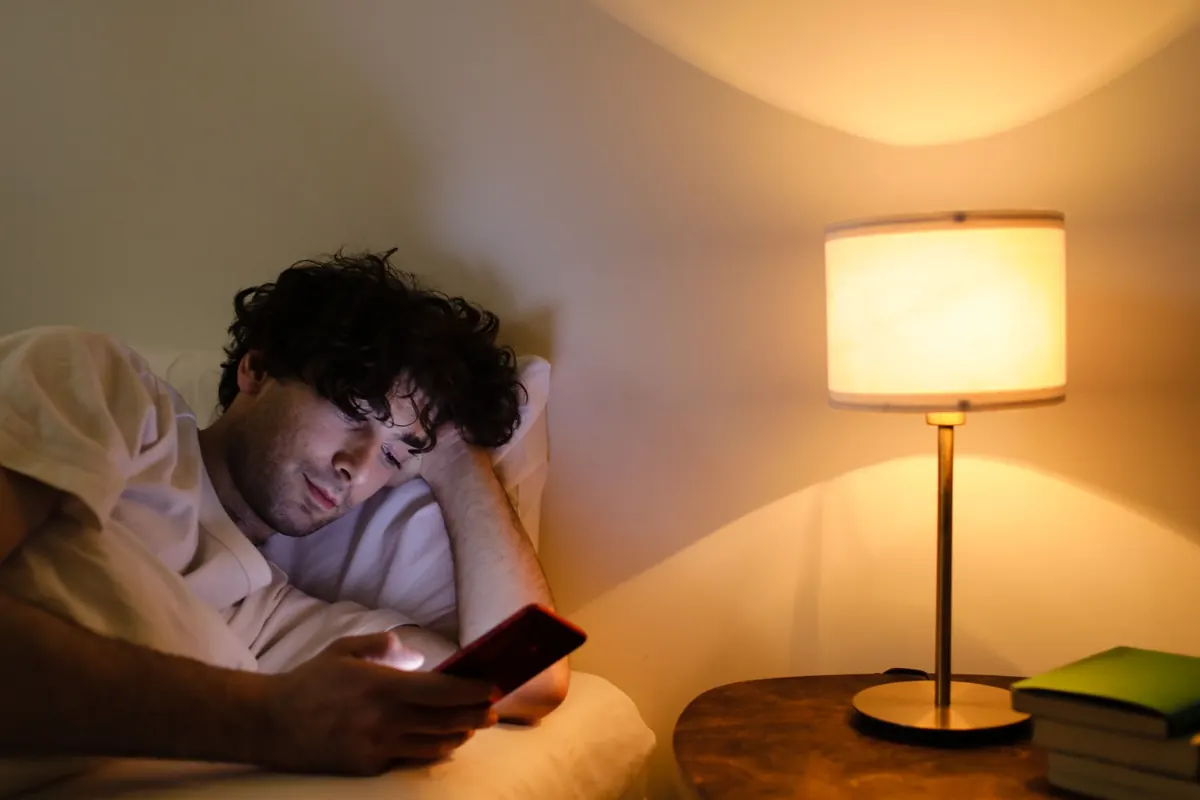
There is a specific kind of tiredness that comes from scrolling in bed: dry eyes, a fizzing head, and no memory of the last forty minutes. You weren't resting and you weren't properly awake either. The usual advice — no screens after eight, phone in another room, read a book instead — is sound in theory and close to impossible on a wet Tuesday when you're behind on messages and your book is downstairs. So here is a smaller proposition. Twenty minutes. Not abstinence, just a buffer.
What twenty minutes actually changes
The point isn't that screens are poison. It's that they keep you in doing mode. Bright light late in the evening can make it harder to feel sleepy, and a stream of messages, headlines and short videos asks your brain to keep responding to things. Twenty minutes of lower stimulation gives your nervous system a chance to change gear before you put your head down.
Think of it as the handbrake turn between your day and your sleep. It is also, importantly, a length of time most people will actually stick to. An hour of virtuous analogue living sounds lovely and rarely survives contact with a real evening. Twenty minutes does.
The routine, minute by minute
You don't need to buy anything or download anything. You need a charger in the wrong place and a rough plan.
- Minutes 0–3: finish on the phone, deliberately. Check whatever genuinely needs checking — tomorrow's first appointment, whether the parcel arrived, the one message that will nag you — then close the apps, set your alarm and plug the phone in somewhere that isn't within arm's reach of the pillow. Across the room is enough. Downstairs is better.
- Minutes 3–6: dim the room. Big light off, lamps on. Low, warm light tells your body the day is winding down in a way that a bright overhead never will.
- Minutes 6–12: do one analogue thing. A paper book, a magazine, a crossword, a notebook. It doesn't have to be improving. A novel you're halfway through beats a self-improvement title you're forcing yourself to read.
- Minutes 12–17: deal with your body. Stretch, shower, brush your teeth, lay out tomorrow's clothes, put a glass of water by the bed. Small physical tasks give your hands something to do that isn't scrolling.
- Minutes 17–20: get into bed with nothing to check. Lights out. If your mind starts listing things, keep a notebook on the bedside table and write down tomorrow's three priorities so you can stop rehearsing them.
What to do with your hands instead
The hardest part of any screen cut is the empty feeling in the first few evenings. Something needs to fill the gap, and it needs to be easy enough that you'll do it when you're tired.
- Read fiction rather than non-fiction — a story pulls you along without asking you to remember anything.
- Keep a puzzle book on the sofa. Crosswords, sudoku, anything with a pen involved.
- Take a warm shower or bath an hour before bed. Many people find the subsequent cooldown makes them feel sleepy.
- Make a caffeine-free drink and sit with it properly, rather than drinking it while doing three other things.
- Try an audiobook or a quiet podcast at low volume with a sleep timer. Audio is a grey area, but it doesn't light up your face and it's much easier to drift off mid-sentence.
- Knit, draw, mend something, potter about with a plant.
- Talk to whoever you live with, or write three lines about your day.
Decide once, not every night
Most evenings don't fail at the willpower stage. They fail at the decision stage. If you have to weigh up whether to put your phone down at half past ten, you will lose that argument more often than you win it.
So make the decisions in advance. Choose a charging spot and use it every night without discussion. Buy a cheap alarm clock so your phone is no longer your wake-up call. Set do-not-disturb hours. Turn the screen to greyscale if you find colour pulls you in. Then attach the whole routine to a trigger you already do — when I put my toothbrush down, the phone goes on the charger — so it runs on habit rather than motivation.
Pick a start time and defend it
Twenty minutes means twenty minutes, so work backwards. If you want lights out at eleven, the routine starts at twenty to. Keep it roughly the same each night; a routine that drifts by two hours isn't really a routine.
When you slip, or genuinely need your phone
Some nights you do need it. A family member is unwell, you're waiting on a work message, you have to book something before it closes. Fine. Do the necessary thing, then put the phone down. The trap is the detour: you open it to reply to one message and surface twenty minutes later in a stranger's comment section.
Missed nights don't undo anything either. This is a default, not an exam. One late scroll does not mean you've broken the habit, and it certainly doesn't mean you should go to bed at nine in a panic to compensate — that usually just leaves you lying awake, cross with yourself.
If you have been sleeping badly for weeks rather than days, or you snore heavily, wake gasping, or feel low in a way that isn't shifting, speak to your GP. Persistent sleep problems often have treatable causes, and no evening routine is a substitute for proper advice.
Your first night
Don't overhaul everything at once. Tonight, do two things: put the charger somewhere other than beside your pillow, and set a timer for twenty minutes before you intend to sleep. When it goes off, dim the lights and pick up something made of paper.
That's the whole experiment. If it helps, repeat it tomorrow, then the night after. After a week or two the twenty minutes stops feeling like a restriction and starts feeling like the part of the evening where you finally stop working. That's usually the point at which people keep it.
Photo: Ron Lach / Pexels